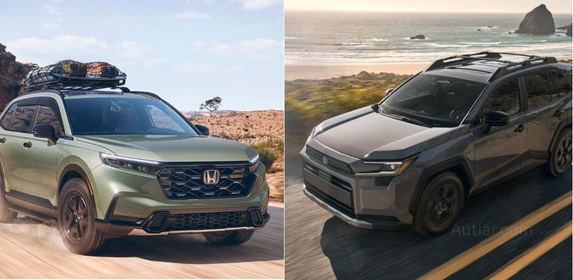
The compact SUV segment remains one of the world’s most competitive, and for 2026 the battle between the Honda CR-V Hybrid and the Toyota RAV4 Hybrid highlights how two established rivals approach electrified mobility differently. Both offer strong hybrid systems, all-weather capability, and family-friendly space, but their design philosophies, performance figures, and feature sets vary in ways that may sway prospective buyers.
Global Strategy & Model Positioning
For the 2026 model year, Toyota has opted to make the RAV4’s electrification central to its identity: the new RAV4 is offered only with hybrid power, including both a traditional hybrid (HEV) and a plug-in hybrid (PHEV) variant—a first for the RAV4’s history.
Honda’s CR-V, by contrast, continues with a hybrid version as part of its broader lineup. The CR-V hybrid shares the sixth-generation CR-V’s comfortable cabin and SUV practicality but does not yet have a plug-in variant widely confirmed for all markets.
Powertrain & Performance Comparison
The RAV4 Hybrid’s powertrain is based on Toyota’s well-established 2.5-liter inline-four hybrid system. In the standard hybrid setup, it produces around 226 hp in front-wheel-drive form and around 236 hp with all-wheel-drive, thanks to the addition of a third motor powering the rear axle.
By comparison, the CR-V Hybrid’s system generates approximately 204 hp combined from its hybrid powertrain. This setup pairs a gasoline engine with electric motors through an e-CVT system, delivering smooth but less powerful performance on paper.
In real-world testing and comparison contexts, the RAV4 Hybrid’s stronger output generally translates to more confident acceleration and greater towing capability. Some sources also indicate the RAV4’s hybrid variants can tow up to around 3,500 pounds on certain trims—a significant advantage over the CR-V’s more modest capacity.
Fuel economy estimates favor the RAV4 as well. Toyota projects combined economy figures as high as 40–45 mpg (U.S. EPA) for the RAV4 Hybrid, whereas Honda’s CR-V Hybrid typically reports figures closer to 36–42 mpg based on available data.
Explore More: 2026 Yamaha YZF-R7 Unveiled with Advanced Features & Upgrades
Interior, Comfort & Practicality
Inside, both SUVs prioritize comfort and usability, but they adopt different design philosophies.
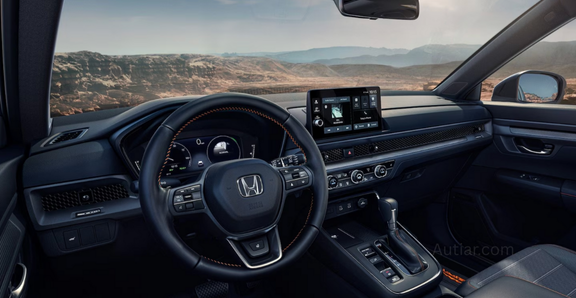
The RAV4’s interior for 2026 features larger infotainment screens and a more modern digital driver display, along with Toyota’s updated software architecture that supports advanced driver aids and connectivity.

The CR-V Hybrid, while not as tech-heavy as Toyota’s newest screens, is frequently noted for its intuitive controls and comfortable seating, with reviewers pointing to the CR-V’s rear legroom as slightly more generous than the RAV4’s.
Cargo space figures vary by configuration, but the RAV4 typically offers more usable cargo volume behind the second row, which benefits weekly errands and road trips alike.
Technology & Safety Suites
Both SUVs come equipped with a suite of active safety technologies as standard, including:
- Adaptive cruise control
- Lane-keeping assist
- Automatic emergency braking
Toyota’s RAV4 includes its latest Toyota Safety Sense suite and often adds features such as a larger infotainment display and advanced driver-assistance enhancements as standard across more trims.
Honda’s CR-V Hybrid also supports Honda Sensing, which includes similar safety features, but the available infotainment hardware in base trims is generally smaller and simpler than in the RAV4.
Pricing, Value & Availability
Exact pricing for 2026 models varies significantly by region and trim. Early indications suggest that base CR-V Hybrid trims may start at a slightly lower price point than comparable RAV4 Hybrid trims, especially when Toyota’s new RAV4 hybrid powertrain and tech are factored in.
However, the RAV4’s standard hybrid powertrain across the lineup and available plug-in hybrid option could deliver more long-term value to buyers prioritizing fuel savings and versatility.
Check This: MINI Countryman SE All4 Debuts in India with AWD and 440km Range
Verdict: Which Makes More Sense?
For buyers prioritizing power output, fuel efficiency, and hybrid technology leadership, the 2026 Toyota RAV4 Hybrid edges ahead with stronger specs, broader hybrid coverage across trims, and more modern digital tech.
For those who value comfortable ride quality, intuitive controls, and slightly more spacious rear seating, the Honda CR-V Hybrid remains a compelling choice in the compact SUV class.
Both remain reliable and practical options with strong resale value, but the edge goes to the RAV4 in terms of overall performance and hybrid credentialing—especially with the plug-in variant available.