All-wheel-drive systems in hybrid vehicles have evolved into two fundamentally different architectures. While both aim to provide traction at all four wheels, mechanical AWD and electric rear-axle AWD differ in layout, performance behavior, efficiency, durability, and long-term ownership implications. Understanding these differences is critical for buyers choosing between hybrid SUVs and crossovers in 2026.
Mechanical AWD: Traditional Torque Distribution
Mechanical AWD systems use a physical driveline connection between the front and rear axles. Power originates from the internal combustion engine and is transmitted through the gearbox, driveshaft, center coupling or differential, and finally to the rear axle. In hybrid vehicles, the electric motor is typically integrated into the transmission or mounted between the engine and gearbox, assisting both axles simultaneously.
This architecture allows continuous torque delivery to all four wheels, independent of battery charge level. Torque distribution may be fixed or variable, depending on whether the system uses a center differential, electronically controlled clutch, or viscous coupling.
Key characteristics:
- Constant mechanical connection between axles
- Rear-wheel drive available at any speed and load
- Torque delivery unaffected by battery state
Mechanical AWD excels in situations requiring sustained traction, such as towing, steep mountain climbs, deep snow, and prolonged off-road use. Because torque is delivered mechanically, there is no reliance on electrical output limits or battery thermal conditions.

However, this design carries penalties. The additional hardware increases vehicle weight and introduces mechanical losses through rotating components. These losses reduce fuel efficiency, particularly during steady cruising when AWD is not required. Mechanical AWD systems also require regular maintenance of differentials, couplings, and lubricants.
Electric Rear-Axle AWD: On-Demand Traction
Electric rear-axle AWD systems eliminate the driveshaft entirely. The front wheels are driven by the engine and hybrid transmission, while the rear wheels are powered by a separate electric motor mounted directly on the rear axle. There is no physical connection between axles; torque distribution is handled entirely by software.
In this configuration, the rear motor activates only when additional traction is required, such as during acceleration, low-grip conditions, or cornering. At steady speeds, the vehicle often operates as front-wheel drive to maximize efficiency.
Key characteristics:
- No mechanical link between axles
- Rear axle engagement is on-demand
- Rear motor output depends on battery capacity and temperature
The primary advantage of electric AWD is efficiency. Removing the driveshaft reduces weight and parasitic losses, improving fuel economy. Electric motors also deliver instant torque, which enhances low-speed traction and stability on slippery surfaces.
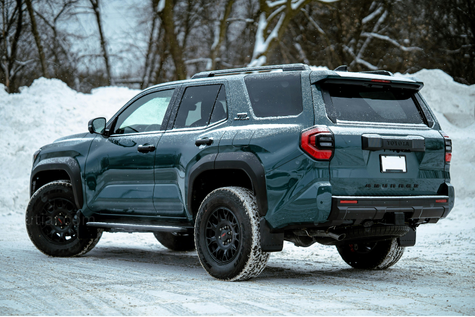
The trade-off lies in sustained performance. Rear electric motors are typically smaller and designed for short bursts rather than continuous high-load operation. Under prolonged stress—such as towing uphill or driving through deep mud—the system may reduce rear torque to protect the motor and battery.
Performance and Driving Behavior
Mechanical AWD systems deliver predictable, linear traction. Drivers experience consistent power delivery regardless of speed or load, making these systems preferable for heavy-duty applications.
Electric AWD systems feel more responsive at low speeds due to instant motor torque. However, rear-axle engagement may vary depending on driving mode, battery state, and thermal limits. This can lead to subtle changes in handling behavior during extended aggressive driving.
From a stability perspective, electric AWD allows precise torque vectoring, as software can adjust rear torque almost instantly. Mechanical systems rely more on physical differentials and braking interventions.
Check This: MINI Countryman SE All4 Debuts in India with AWD and 440km Range
Efficiency and Emissions Impact
Electric AWD systems generally achieve better fuel economy because the rear axle is disengaged when not needed. This makes them well-suited for urban driving and mixed-use scenarios.
Mechanical AWD systems incur a constant efficiency penalty, even when traction demands are low. In markets with strict emissions targets, this disadvantage has contributed to the rise of electric AWD solutions.
Reliability and Ownership Considerations
Mechanical AWD systems use well-established components with predictable wear patterns. While maintenance requirements are higher, failures are generally mechanical and easier to diagnose.
Electric AWD introduces additional complexity:
- Rear motor cooling systems
- High-voltage cabling
- Power electronics
Long-term reliability depends heavily on thermal management and battery health. While mechanical wear is reduced, electronic components can be costly to replace.
Application Suitability
Mechanical AWD is better suited for:
- Towing-focused vehicles
- Large SUVs
- Continuous off-road use
Electric AWD is better suited for:
- Compact and midsize hybrids
- Urban and mixed driving
- Efficiency-focused buyers
Explore More: 2026 Yamaha YZF-R7 Unveiled with Advanced Features & Upgrades
Conclusion
Mechanical and electric AWD systems reflect different engineering priorities. Mechanical AWD emphasizes durability and continuous torque delivery, while electric rear-axle AWD prioritizes efficiency and responsiveness. Neither system is inherently superior; suitability depends on vehicle size, intended use, and driving environment. As hybrid technology matures, both architectures will continue to coexist, serving different buyer needs.